
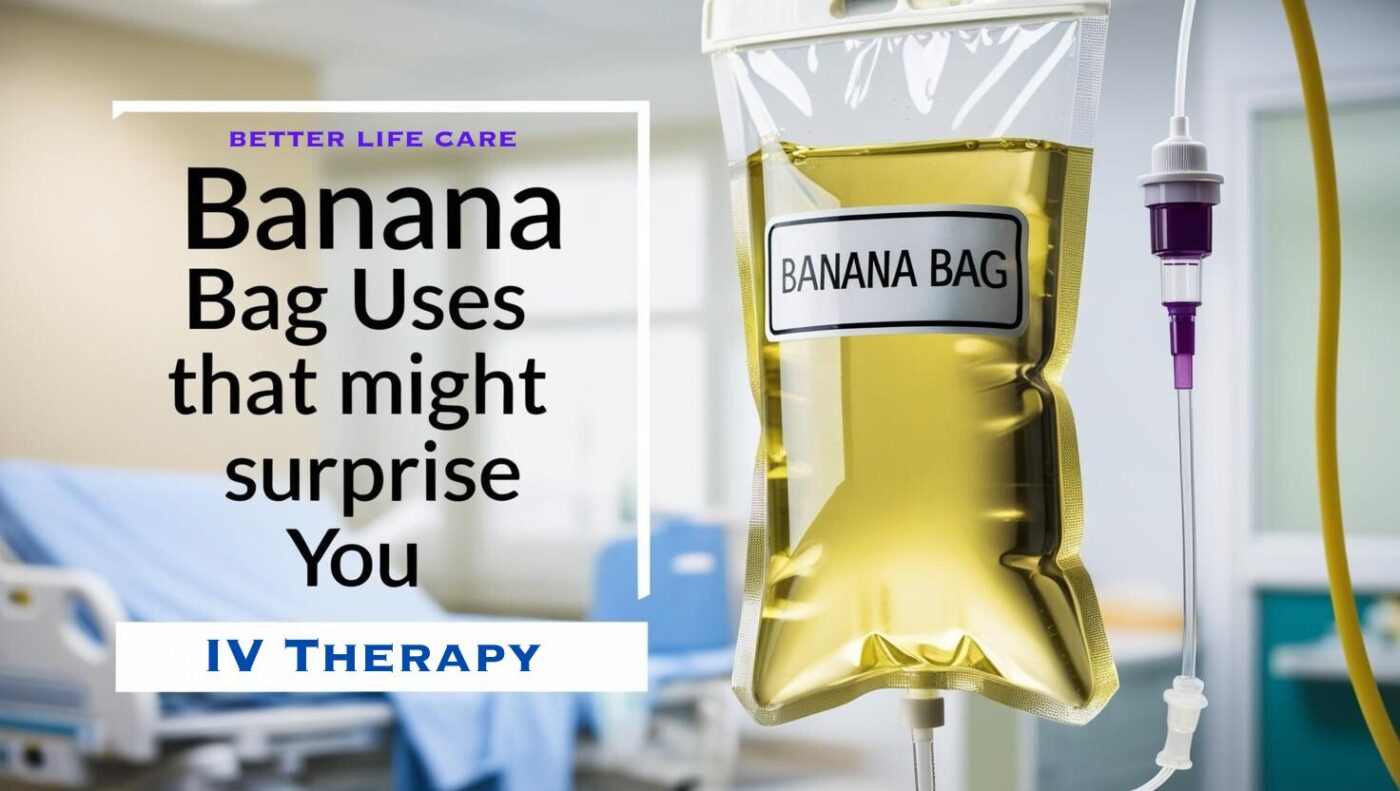
That bright yellow IV bag on the mobile drip menu, the one promising to erase a hangover while you lie on your couch, began as a hospital staple for patients dangerously low on vitamins. A banana bag IV is typically about 1 liter (roughly 34 ounces) of fluid with thiamine, folic acid, a multivitamin and magnesium mixed in. Here’s what it actually does, and whether an at-home drip is worth your money.
What Is a Banana Bag?
A banana bag is an IV drip of fluids, vitamins and minerals. Hospital staff nicknamed it for the bright yellow color it turns once the vitamins go in. There’s no official medical name and no single recipe, but a typical bag starts with about 1 liter (roughly 34 ounces) of saline (salt water) or dextrose (a sugar solution), plus:
- Thiamine (vitamin B1): often around 100 mg
- Folic acid (vitamin B9): often around 1 mg
- A multivitamin preparation: includes riboflavin (vitamin B2), which turns the bag yellow
- Magnesium sulfate: often 1 to 2 grams
Thiamine is the star. In people who drink heavily or eat poorly, very low levels can lead to Wernicke’s encephalopathy, a serious brain condition that causes confusion and unsteady walking.
A nurse runs the bag slowly through a vein, usually over several hours, and monitors the patient throughout. Doses vary between hospitals and are adjusted for each person. The amounts above are typical examples, not dosing advice.

What Banana Bags Are Used For in Hospital
Picture a patient admitted after days of heavy drinking, barely eating, maybe vomiting. Their blood work can take hours, but some vitamin shortages can’t wait that long. That’s the gap a banana bag fills. Doctors order it mainly to correct or prevent deficiencies in people who can’t take in or absorb enough nutrients by mouth. The most common groups:
- People with alcohol use disorder: Heavy drinking cuts how much thiamine, folate and magnesium your body absorbs and stores. Many people who drink heavily also eat very little, so the shortfall builds from both sides.
- People with malnutrition: This can come from eating disorders, cancer, digestive diseases or long stretches of poor eating, which is common in frail older adults.
- Severe or prolonged vomiting: One example is hyperemesis gravidarum, a severe form of pregnancy sickness where food and fluids won’t stay down for days.
- Dehydration on top of one of these: The fluid in the bag rehydrates while the vitamins and minerals restock what’s been lost.
You’ll often see a banana bag hung during a hospital stay for alcohol withdrawal. It’s worth being clear about its role there, though. The bag replaces nutrients. It doesn’t calm the shakes, sweating or agitation of withdrawal, which doctors treat with separate medications and close monitoring.
And hangovers? Hospitals don’t use banana bags for those. The bag exists for people at real risk of dangerous deficiencies, not for a rough Sunday morning.
Why thiamine matters so much
Thiamine, also called vitamin B1, helps your cells turn food into energy. Your brain burns through a lot of energy, so it’s hit hardest when thiamine runs low. A serious shortage can cause Wernicke encephalopathy, a brain emergency marked by confusion, unsteady walking and unusual eye movements, such as eyes that flicker or can’t move normally.
Here’s the catch: many people with Wernicke don’t show all three signs at once. Some only seem confused or a bit “off,” which is why doctors treat high-risk patients early instead of waiting for a textbook picture. Left untreated, it can progress to Korsakoff syndrome, a lasting memory disorder. People who drink heavily carry the highest risk, but severe malnutrition and long-term vomiting can trigger it too.
There’s also a timing rule hospital teams take seriously. In someone low on thiamine, giving sugar-containing IV fluids first can use up what little thiamine remains and may tip them into Wernicke. So thiamine typically goes in before or alongside glucose, never after.
One important nuance: when Wernicke encephalopathy is suspected, doctors usually give much higher IV doses of thiamine than a standard banana bag contains. Think of the banana bag as routine replacement for at-risk patients, not a treatment for the condition itself. Some researchers have also questioned whether every patient who gets one needs it, and many hospitals now tailor vitamins to the individual rather than hanging the same bag for everyone.
If someone who drinks heavily suddenly becomes confused, can’t walk steadily or has strange eye movements, treat it as an emergency and call 911. This isn’t something to manage at home.
Magnesium and folate
Low magnesium is common in heavy drinkers. It can cause muscle cramps, tremor and heart rhythm problems. It also makes low potassium stubborn to fix, because your kidneys keep losing potassium until magnesium is back to normal. That’s one reason doctors often replace both together.
Folate, a B vitamin your body needs to make healthy red blood cells, tends to run low with heavy drinking and poor diet. A shortage can cause a type of anemia, a lack of healthy red blood cells, where the cells come out too large and don’t carry oxygen well. That can leave you tired, pale and short of breath.
The good news? Both are easy to check with routine blood tests and usually straightforward to correct. In people who are severely malnourished, doctors also watch closely when eating restarts. A condition called refeeding syndrome can cause sudden, dangerous drops in minerals like phosphate, potassium and magnesium. A banana bag is one small part of that careful restart, not the whole plan.
Banana Bags and Wellness IV Drips
Outside the hospital, the banana bag has picked up a second career. IV vitamin drips are now sold at strip-mall clinics, med spas and through mobile services that come to your home or hotel room. They go by names like “hangover bag,” “Myers’ cocktail” or “immunity drip.” Some are sold as banana bags, a nod to that yellow hospital mix.
The pitch is broad: faster hangover recovery, less jet lag, more energy, better workout recovery, glowing skin and a stronger immune system. A single session often costs a hundred dollars or more, and health insurance usually won’t cover it.
So does it work? For most healthy people, the evidence is weak. According to Cleveland Clinic, there is little research showing that IV vitamin therapy benefits healthy people who aren’t deficient. Here’s what’s actually going on:
- Extra vitamins don’t equal extra energy: If your levels are already normal, your kidneys filter out the excess water-soluble vitamins, like B vitamins and vitamin C. Much of a pricey drip can end up in your urine.
- Food usually does the job: Most people absorb vitamins well from what they eat. When a true deficiency shows up, oral supplements work for most people unless a gut absorption problem gets in the way.
- The fluid is likely doing the heavy lifting: A drip typically holds about 1 liter (roughly 34 ounces) of fluid, which can ease mild dehydration. You can often get the same effect by drinking water or an oral rehydration solution. Our guide to how much water you really need covers daily needs.
- Hangovers are more than dehydration: Inflammation, poor sleep and the toxic breakdown products of alcohol all play a part. No IV drip has been proven to cure a hangover.
What about a banana bag IV at home?
Home IV services are convenient, but convenience isn’t the same as safety. Any IV means putting a needle in a vein, which carries small but real risks: bruising, vein irritation, infection, and fluid leaking into the tissue around the site. People with heart or kidney problems can also struggle to handle a fast liter of fluid.
If you’re still curious, ask who is placing the line, whether a licensed clinician reviewed your health history and medications, and what happens if something goes wrong. And if you’re shaky, sweating or confused after stopping heavy drinking, skip the drip service. Those can be signs of alcohol withdrawal, which needs a real medical evaluation.

Hospital Banana Bag vs Wellness Drip vs Oral Options
The same yellow bag can mean two very different things. In a hospital, it’s a targeted treatment for someone whose body may be running low on key nutrients. At a strip-mall IV lounge, it’s usually a pricey pick-me-up for someone who’s mostly fine. Here’s how those two compare with plain food, fluids and tablets.
| Hospital banana bag | Wellness IV drip | Food, fluids and tablets | |
|---|---|---|---|
| Who it is for | People with or at risk of deficiency, such as heavy drinkers or malnourished patients | Mostly healthy people | Almost everyone |
| Evidence | Reasonable for replacing nutrients in at-risk patients | Weak | Strong for most needs |
| Medical assessment | Yes, with blood tests | Varies, often limited | Not usually needed |
| Risks | Low, monitored | Low but real: infection, vein irritation, fluid overload | Very low |
| Cost | Part of hospital care | Often 100 to 300 dollars or more per session | Low |
What This Means for You
The biggest difference isn’t what’s in the bag. It’s who decides you need it. In a hospital, a doctor orders a banana bag based on your history, symptoms and lab results, and nurses watch you while it runs. That’s why the evidence column looks reasonable there and weak everywhere else.
A wellness drip often skips most of that. Some clinics do a short health questionnaire and a quick vitals check. Others do less. The fluids and vitamins themselves are usually low risk for a healthy adult, but any needle in a vein carries a small chance of infection or irritation. People with heart or kidney problems can also run into trouble with extra fluid.
So what about the hangover or the rough Monday? For most people, the boring option wins. Water or an electrolyte drink, a real meal, rest and time handle mild dehydration well, and your gut absorbs most vitamins just fine on its own. A basic multivitamin costs pennies a day by comparison.
There’s one clear exception. If you can’t keep anything down, feel confused, have a racing heart, or are going through alcohol withdrawal (shaking, sweating, seeing or hearing things), skip the IV lounge and get a real medical evaluation. Those situations need a doctor, not a drip menu.
Risks and Side Effects
An IV is a medical procedure, even when it happens in a spa with soft lighting or on your living room couch. A needle goes into your vein, and whatever is in the bag goes straight into your bloodstream, with no stomach or liver to filter it first. Most drips go smoothly, but these are the problems worth knowing about:
- Bruising, pain or swelling: These can show up where the needle goes in, along with irritation of the vein (phlebitis, a sore, red, tender streak along the vein).
- Infection: This can happen if the equipment or fluids are not sterile. The US Food and Drug Administration has warned about compounded drug products made in medical offices and clinics under insanitary conditions.
- Fluid overload: People with heart failure or kidney disease can’t always handle a large volume of fluid and may become short of breath.
- Problems from minerals given too fast or in too high a dose: These include flushing, low blood pressure or heart rhythm changes from magnesium or potassium.
- Allergic reactions: These are rare but possible, which is one reason trained staff should stay nearby during the infusion.
Speed matters more than most people realize. In the hospital, a banana bag is usually run slowly over several hours, and nurses watch your heart rate and blood pressure while it drips. A wellness clinic promising a 30-minute “express” version is working with a much thinner safety margin.
When to Get Help During or After an IV
Tell staff right away if you feel chest pain, a racing or pounding heart, trouble breathing, dizziness, itching or hives, or swelling in your face or throat. Call 911 if those symptoms start after you’ve left or the mobile nurse has gone home. Spreading redness, warmth or pus at the needle site, or a fever in the days afterward, also deserves a prompt call to your doctor.
If you still want a wellness drip, set a few ground rules. Make sure a doctor or nurse reviews your medical history first, check that staff are licensed in your state, and skip it if you have heart, kidney or liver disease, or are pregnant, unless your own doctor agrees.
Better Ways to Feel Better
Here’s the thing: most of what a banana bag promises, you can get more cheaply and safely without a needle in your arm. The right fix depends on why you feel lousy in the first place.
- For a hangover: sip water or an oral rehydration drink, eat something simple like toast or eggs, and rest. Time does most of the work. Be careful with acetaminophen (Tylenol) after heavy drinking, because alcohol and acetaminophen both put strain on your liver, so check with a pharmacist before you take any.
- For a stomach bug: take small, frequent sips of fluid, even just a spoonful or two every few minutes if that’s all your stomach will allow. Our guide to recovering from a stomach bug at home explains when IV fluids are actually needed.
- For low energy: ask your doctor about a blood test that checks iron, vitamin D and B12, and take a hard look at your sleep, rather than guessing with a drip. See our guide to energy crashes for everyday fixes that may help.
- For immunity: the unglamorous basics of steady sleep, regular movement, a varied diet and staying up to date on vaccines matter far more than a vitamin infusion. Our article on daily habits that support immunity covers what helps.
- If you drink heavily: thiamine (vitamin B1) tablets recommended by your doctor, plus real support to cut down, will do far more for your health than an occasional drip. Stopping suddenly after heavy daily drinking can be dangerous, so get medical advice before you quit.
That last point matters most. People who drink heavily are exactly who hospitals give banana bags to, yet a drip at a wellness bar can offer them false reassurance. It doesn’t treat withdrawal or undo the damage, and some warning signs need emergency care, not a vitamin top-up.
If you’d rather watch than read, the video below offers more background on this topic.
How Fast Is a Banana Bag Infused?
Slower than most people expect. In the hospital, a banana bag is usually given over several hours, not dripped in during a quick 30-minute visit. Many hospital protocols run one bag over roughly 4 to 8 hours, though the exact speed depends on the patient and on local policy.
Why so slow? A few reasons stack up.
- Magnesium needs time: When magnesium is added, pushing it in too fast can cause flushing, a warm feeling, and drops in blood pressure.
- The heart and kidneys set limits: A full bag is usually about 1 liter (roughly 34 ounces) of fluid. That’s easy for a healthy young adult, but it can overload someone with heart failure or kidney disease.
- Vein comfort: Some additives can sting or irritate the vein if they run in quickly.
The rate isn’t something you choose. A doctor writes the order, and a nurse sets the pump based on your vital signs, lab results, and health history. If you ever feel chest tightness, trouble breathing, or swelling while an IV is running, tell the nurse right away.
Can You Get a Banana Bag IV at Home?
Sort of. A true hospital banana bag is a treatment for people who are seriously depleted, often because of heavy alcohol use, malnutrition, or long bouts of vomiting. What mobile IV companies sell as a “banana bag” is usually a vitamin-and-fluid drip inspired by the hospital version, and the ingredients can vary a lot from one company to the next.
In most states, these services need a licensed prescriber to approve the drip and a nurse or other trained clinician to place the IV. Rules differ by state, so it’s fair to ask who the supervising medical provider is before anyone touches a needle.
What a home IV visit usually looks like
Here’s the typical flow, so you know what a careful service should be doing.
Who should skip it
Home drips carry real, if uncommon, risks: infection at the needle site, bruising, fluid leaking into the tissue around the vein, and fluid overload. Talk to your doctor first if you have heart failure, kidney disease, high blood pressure, or you’re pregnant.
One situation deserves a hard stop. Alcohol withdrawal is not a home IV problem. Shaking, sweating, a racing heart, confusion, or hallucinations after cutting back on heavy drinking can lead to seizures. A vitamin drip won’t prevent that. Those symptoms mean urgent medical care.
Banana Bag vs. Hangover Drip vs. Drinking Water
If you landed here after a rough Saturday night, this is probably the comparison you want. The short answer? An IV can make you feel rehydrated faster, but there’s little good evidence that it fixes a hangover better than fluids, food, rest, and time.
| Option | What’s usually in it | Best suited for | Main drawback |
|---|---|---|---|
| Hospital banana bag | Fluid, thiamine, folate, multivitamin | Malnutrition, heavy alcohol use | Requires a medical setting |
| Mobile “hangover drip” | Fluid, vitamins, sometimes anti-nausea meds | Healthy adults wanting convenience | Costly, mostly out of pocket |
| Water or electrolyte drink | Fluid, sodium, potassium, sugar | Most ordinary hangovers | Hard if you’re vomiting |
For a typical hangover, sipping water or an oral rehydration drink, eating something bland like toast or bananas, and sleeping it off covers the basics for most people. An IV starts to make more sense when you can’t keep fluids down at all.
If you’re vomiting for hours, can’t stay awake, are breathing slowly, or seem confused, that’s not a hangover to treat at home. It can signal alcohol poisoning, and it needs emergency care.
FAQ
Why is it called a banana bag?
Because of its yellow color, which comes from riboflavin (vitamin B2) in the multivitamin. It contains no bananas.
Does a banana bag cure a hangover?
No. The fluid can ease dehydration, but there is no good evidence that IV vitamins cure a hangover. Water, food, rest and time are what help.
How long does a banana bag take?
In hospital it is usually given over several hours. Wellness clinics often run drips over 30 to 60 minutes.
Is a banana bag safe?
Given in hospital to the right patient, it is low risk. Outside hospital, risks such as infection and fluid overload are small but real, and the benefit for healthy people is unproven.
Can I get the same nutrients from tablets?
For most people, yes. Food and oral supplements correct most deficiencies. IV vitamins are mainly for people who cannot eat, cannot absorb nutrients or need them urgently.
The Bottom Line
A banana bag is an IV fluid with thiamine, folic acid, a multivitamin and magnesium. In hospital it is a sensible, low-risk way to replace nutrients in people with heavy alcohol use, malnutrition or severe vomiting, and to help protect against thiamine deficiency. As a wellness treatment for hangovers, energy or immunity, the evidence is weak, and the same benefits usually come from fluids, food and, if needed, a tested and targeted supplement.
This article is for general information and is not a substitute for advice from your doctor.
Sources
- Cleveland Clinic: Does IV Vitamin Therapy Work?
- NIH Office of Dietary Supplements: Thiamin
- NIH Office of Dietary Supplements: Magnesium
- MedlinePlus: Wernicke-Korsakoff Syndrome
Medical disclaimer: This article is for general information only and is not a substitute for advice, diagnosis or treatment from a qualified health professional. If your symptoms are severe, sudden or getting worse, contact a doctor or emergency services.

Everyday Health and Wellness
Browse every related article on this topic in one place.