
Why Your Lower Back Always Pays the Price First
Your lower back has been quietly absorbing the cost of every hour you’ve spent sitting at a desk, hunched over a phone, or driving longer than you planned. By the time you feel it, the tension has usually been building for weeks.
- Why Your Lower Back Always Pays the Price First
- What Actually Causes Lower Back Tension?
- What Does the Research Actually Say?
- The Best Yoga Poses for Lower Back Tension
- How Often Should You Practice?
- Common Myths About Yoga and Lower Back Pain
- What Yoga Won't Fix
- Making It a Habit Without Overhauling Your Life
- When Should You See a Professional?
- FAQ
- The Bottom Line
According to the Mayo Clinic, lower back pain is one of the most common reasons Americans see a doctor or miss work. The good news: for non-specific lower back tension, meaning achiness and stiffness without a serious underlying cause, gentle movement is almost always more helpful than staying still. Yoga poses have been studied for exactly this.
What Actually Causes Lower Back Tension?
Lower back tension usually comes from muscle tightness, poor posture over long stretches, or a mismatch between how much your body moves and how much it was built to move. Your lumbar spine, the five vertebrae in your lower back, is designed for both stability and motion. When it gets too little of either, something complains.
Prolonged sitting is the biggest culprit. When you sit for hours, your hip flexors, the muscles at the front of your hips, shorten and tighten. That pulling effect tilts your pelvis forward and compresses the lower lumbar vertebrae. Your glutes, the muscles that normally help support your spine, essentially go dormant. The result? The small muscles along your spine end up overworked and stiff by 3 PM.
Stress plays a role too. Chronic stress causes your body to hold tension in predictable places, and the lower back is one of the most common. If you’ve noticed your back tightening during a rough work week, you’re not imagining it. Harvard Health regularly addresses the mind-body connection in back pain because the research backs it up.
If tension also creeps up toward your neck and shoulders, the piece on neck stretches for desk workers covers that territory.
What Does the Research Actually Say?
The evidence is genuinely encouraging. A 2017 clinical trial published in Annals of Internal Medicine found that yoga was as effective as physical therapy for reducing chronic lower back pain and improving function over a year. A Cochrane review, one of the most rigorous types of research summaries available, concluded that yoga probably improves back-related function and may reduce pain compared to no exercise.
The key word is “chronic” or “non-specific” back pain. Yoga has been studied for everyday tension and muscular aching, not for structural problems like herniated discs, spinal stenosis, or fractures. That distinction matters.
For people who sit most of the day, the case for yoga is particularly strong. Movement consistently outperforms bed rest for this type of pain. Yoga sits firmly in the “keep moving” camp, with the added benefit of intentional stretching and breathing.
The Best Yoga Poses for Lower Back Tension
These poses are chosen specifically for the lower back, based on what’s been used in clinical yoga studies and what physical therapists commonly recommend. You don’t need prior yoga experience. You need a mat, a little floor space, and about ten minutes.
Child’s Pose (Balasana)
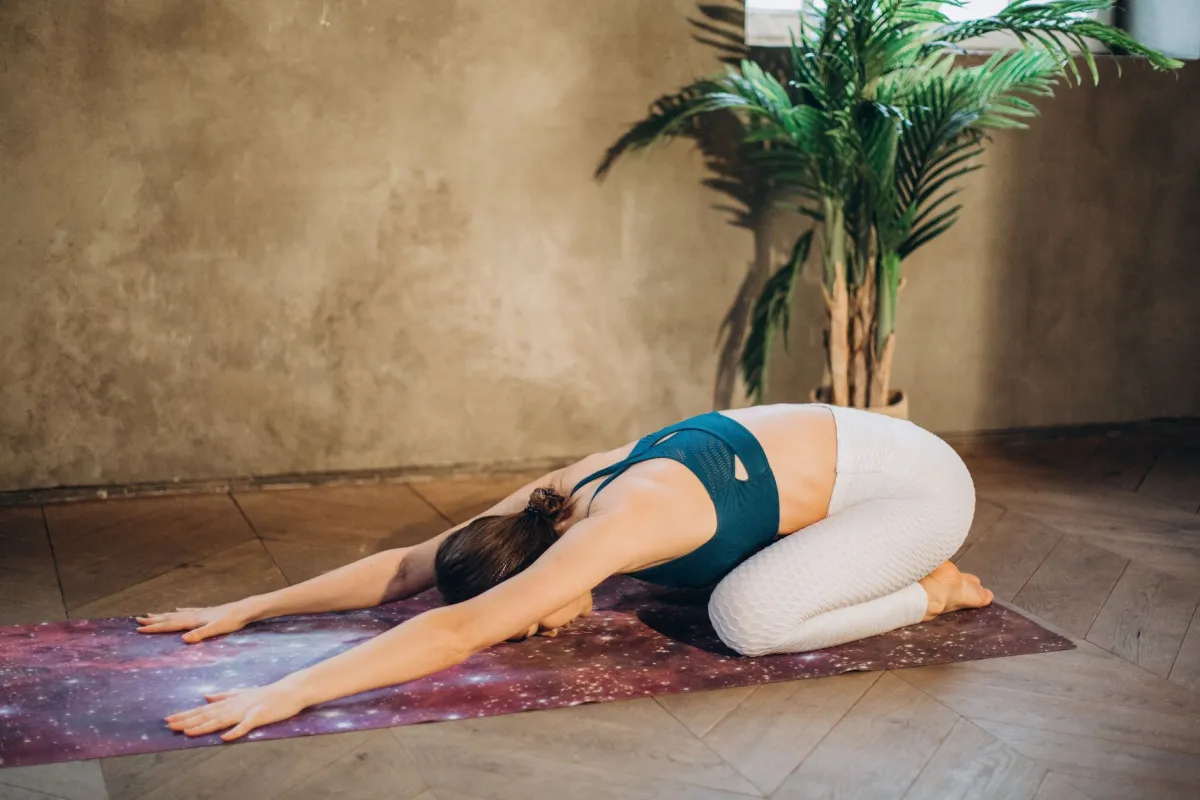
Child’s Pose is the most universally recommended yoga position for lower back relief, and for good reason. Kneeling and folding forward gently decompresses your lumbar spine while stretching the muscles along your back, hips, and thighs. It’s also a natural resting pose, so if something feels like too much, this is where you return.
To do it: Kneel on the floor, sit back toward your heels, and stretch your arms forward on the mat with your forehead resting down. Hold for 5 to 10 slow breaths. If your hips don’t reach your heels, place a folded blanket between your thighs and calves for support.
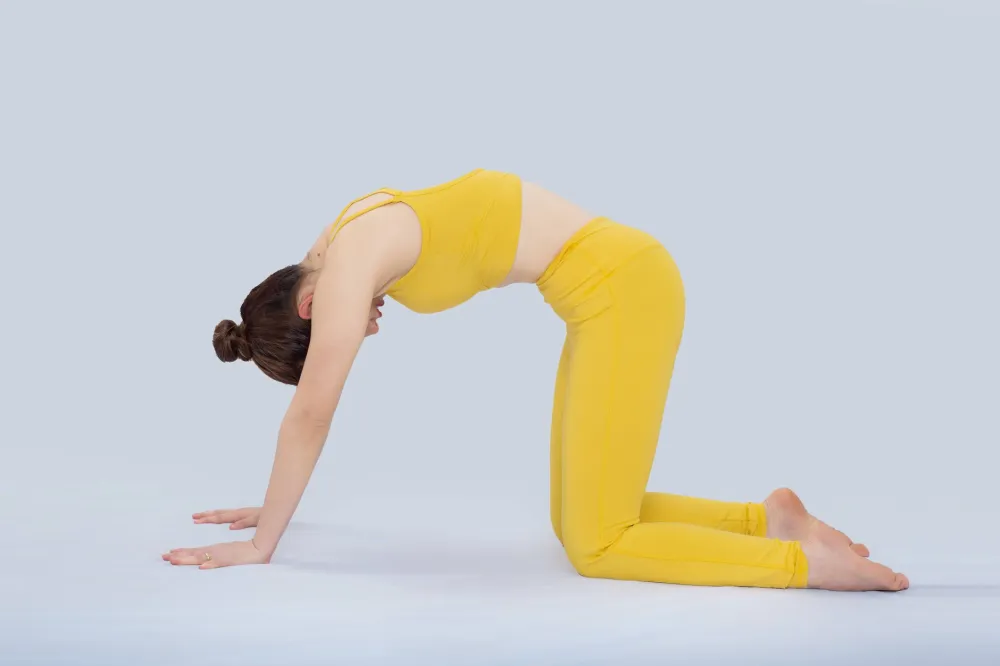
Cat-Cow (Marjaryasana-Bitilasana)
This two-part movement warms up the spine before anything else. It moves your lower back through gentle flexion and extension, which increases circulation to the discs and loosens the paraspinal muscles, the long muscles that run along either side of your spine.
Start on hands and knees with your wrists under your shoulders and knees under your hips. On an inhale, drop your belly toward the floor and lift your head and tailbone (Cow). On an exhale, round your spine toward the ceiling and tuck your chin and pelvis (Cat). Repeat for 8 to 10 slow breath cycles. Move at the pace of your breath, not the clock.
Supine Spinal Twist (Supta Matsyendrasana)
Lying on your back and letting your knees fall to one side gives the muscles along your lumbar spine a passive, gravity-assisted stretch. Many people feel an almost immediate sense of release, particularly on the side holding the most tension.
Lie on your back, hug both knees to your chest, then let them fall slowly to the right while you extend your arms out to the sides. Keep both shoulders on the floor. Hold for 5 to 8 breaths, then repeat on the left. Don’t force your knees to the floor if they don’t go easily. Let gravity do the work.
Legs-Up-the-Wall (Viparita Karani)
This one looks almost too simple to work, but it’s surprisingly effective. Resting your legs vertically against a wall removes compressive load off your lumbar spine and allows the muscles there to release without any effort. It’s also calming for your nervous system, which matters more than people realize for stress-related back tension.
Sit sideways next to a wall, then swing your legs up as you lie back. Scoot your hips as close to the wall as feels comfortable. Stay here for 3 to 10 minutes. This works particularly well at the end of the day.
Low Lunge (Anjaneyasana)
Remember the hip flexor problem mentioned earlier? Low Lunge addresses it directly. When hip flexors are chronically tight, they pull your pelvis into an anterior tilt, which compresses the lower lumbar vertebrae. Stretching them in a low lunge can take some of that pressure off almost immediately.
From a kneeling position, step your right foot forward so your right knee is over your right ankle. Keep your left knee on the floor and gently press your hips forward and down until you feel a stretch at the front of the left hip. Hold for 5 to 8 breaths, then switch sides. Avoid letting the front knee push past your toes.
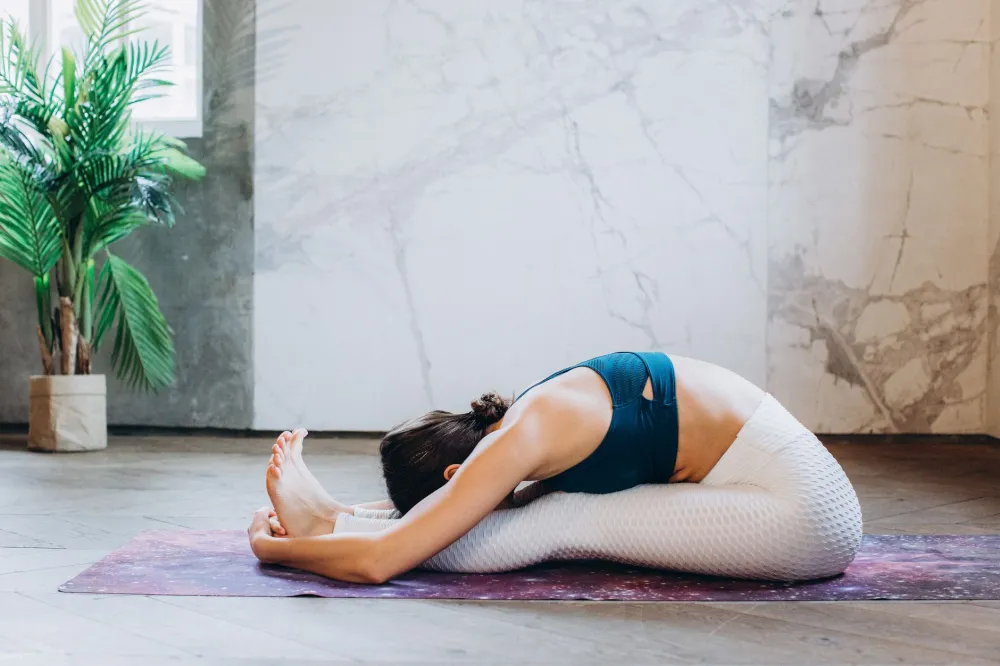
Seated Forward Fold (Paschimottanasana)
Sit on the floor with legs extended and hinge forward from your hips, not your waist. This stretches your hamstrings and the entire posterior chain, the muscles running up the back of your legs and spine. Tight hamstrings are a surprisingly common contributor to lower back tension because they limit how your pelvis can move and force your lumbar spine to compensate.
Reach for your shins, ankles, or feet, wherever you can go without rounding aggressively. Use a yoga strap or a towel looped around your feet if reaching is uncomfortable. Hold for 5 to 10 breaths, keeping your spine as long as possible rather than collapsing into a full rounding.
How Often Should You Practice?
Research typically used yoga sessions two to three times per week, with sessions ranging from 45 to 75 minutes. But for everyday tension relief, even a 10-minute daily practice using the poses above is likely to help, especially if you’re consistent.
Here’s a realistic starting point based on what research suggests:
| Goal | Frequency | Session Length | What to Expect |
|---|---|---|---|
| Quick daily relief | Daily | 10 minutes | Reduced stiffness in 1-2 weeks |
| Longer-term pain reduction | 3-4 times per week | 20-40 minutes | Meaningful improvement by 6-8 weeks |
| Maintenance after relief | 2-3 times per week | 15-20 minutes | Sustained comfort with consistency |
If you’re new to yoga and want a structured starting point for busy mornings, the guide on 10-minute morning yoga routines is worth bookmarking alongside this one.
Common Myths About Yoga and Lower Back Pain
A few misconceptions keep people either avoiding yoga entirely or practicing it in ways that backfire.
Myth: You need to be flexible first. This is completely backward. You start yoga to become more flexible, not after. Every pose described above works for beginners, and props like blankets, yoga blocks, and straps exist precisely for people who can’t touch their toes yet.
Myth: If it hurts, push through it. No. A good stretch feels like a gentle pulling sensation. Sharp, shooting, or stabbing pain during a pose is a signal to stop, back off, and possibly see a provider. Yoga for back tension should feel relieving, not like an endurance test.
Myth: Only intense yoga is worth doing. Most clinical trials for lower back pain have used gentle styles like Hatha rather than vigorous flow classes. More sweat does not mean more back relief. If you’re interested in rebuilding overall flexibility through yoga, the article on flexibility after 40 makes a strong case for slow and steady.
Myth: Yoga replaces physical therapy. For everyday tension, yoga may be all you need. But for recurring or severe back problems, a physical therapist can assess the specific muscles and movement patterns contributing to your pain in ways a general yoga class cannot.
What Yoga Won’t Fix
Yoga is excellent for muscular tension, postural strain, and stress-related back tightness. It’s less appropriate, and potentially harmful without professional guidance, for conditions involving structural damage.
If your back pain is related to a herniated or bulging disc, spinal stenosis (narrowing of the spinal canal), or spondylolisthesis (where one vertebra slips over another), you can still do yoga. But get cleared by a doctor or physical therapist first and ideally work with a teacher trained in therapeutic yoga. Some poses that help most people can aggravate these conditions.
Back pain sometimes originates from sources that have nothing to do with the spine itself. Issues with the kidneys, pelvic organs, or digestion can all refer pain to the lower back. If your aching doesn’t improve with movement, feels worse at rest than during activity, or comes with other symptoms like fever, unexplained weight loss, or numbness running down your legs, see a doctor rather than stretching it out.
For people dealing with back pain that flared up after exercise, the article on back pain after the gym breaks down what’s likely happening and what actually helps in those specific situations.
Making It a Habit Without Overhauling Your Life
The biggest obstacle to yoga for back pain isn’t motivation, it’s logistics. People think they need a studio membership, an hour of free time, and some kind of spiritual commitment. None of that is true.
A practical approach that works for most people:
- Tie it to something you already do. Right after waking up, before your morning coffee, or immediately after work are natural anchor points.
- Keep the mat out. A rolled-up mat in a closet is a mat that doesn’t get used. Leaving it on the floor in a visible spot is a surprisingly effective cue.
- Start with just two poses. Child’s Pose and Cat-Cow together take under five minutes. That’s a legitimate starting point.
- Pair it with something enjoyable. A podcast, a playlist, or ten minutes of quiet can make the difference between a habit that sticks and one that doesn’t.
- Use your desk as a prompt. If your back tightens while sitting, that discomfort is a useful reminder. A two-minute Cat-Cow break at your desk counts, even on the floor if needed.
The broader guide on desk posture and back pain from sitting all day pairs well with this if your tension is primarily work-related. If stress is clearly part of the picture, the piece on beginner meditation without the mysticism covers a complementary approach that many people find helps the nervous system component of chronic tension.
When Should You See a Professional?
Most everyday lower back tension doesn’t require a medical appointment. But see your doctor if your back pain is severe, lasts more than a few weeks without improvement, follows an injury, or comes with any red-flag symptoms listed above.
A physical therapist is a particularly good resource if you want a movement assessment tailored to your specific situation, or if you’ve tried yoga consistently and haven’t seen improvement. Some people also benefit from working with a certified yoga therapist, a practitioner trained specifically to adapt yoga for people with injuries or chronic conditions, which is different from a standard yoga teacher certification.
If you’re dealing with something more structural, spinal decompression therapy is one option that a qualified provider might discuss with you, though as with any intervention, it’s worth understanding the evidence and whether it’s appropriate for your situation.
FAQ
The Bottom Line
Yoga poses like Child’s Pose, Cat-Cow, the Supine Spinal Twist, Low Lunge, and Legs-Up-the-Wall are among the most well-researched and practically accessible tools for easing lower back tension. Consistent practice, even just 10 minutes a day, may meaningfully reduce everyday aching and stiffness within a few weeks. The key is showing up regularly, moving gently, and paying attention to what your body tells you. If your pain is severe, persistent, or comes with concerning symptoms, see a healthcare provider first, not last. For everyday tension from sitting too long and moving too little, your mat is one of the most useful things in your home.
This article is for informational purposes only and is not a substitute for professional medical advice, diagnosis, or treatment. Always consult a qualified healthcare provider about your specific situation. If you experience severe or sudden symptoms, seek medical care immediately.
Sources

Back and Neck Pain
Browse every related article on this topic in one place.