

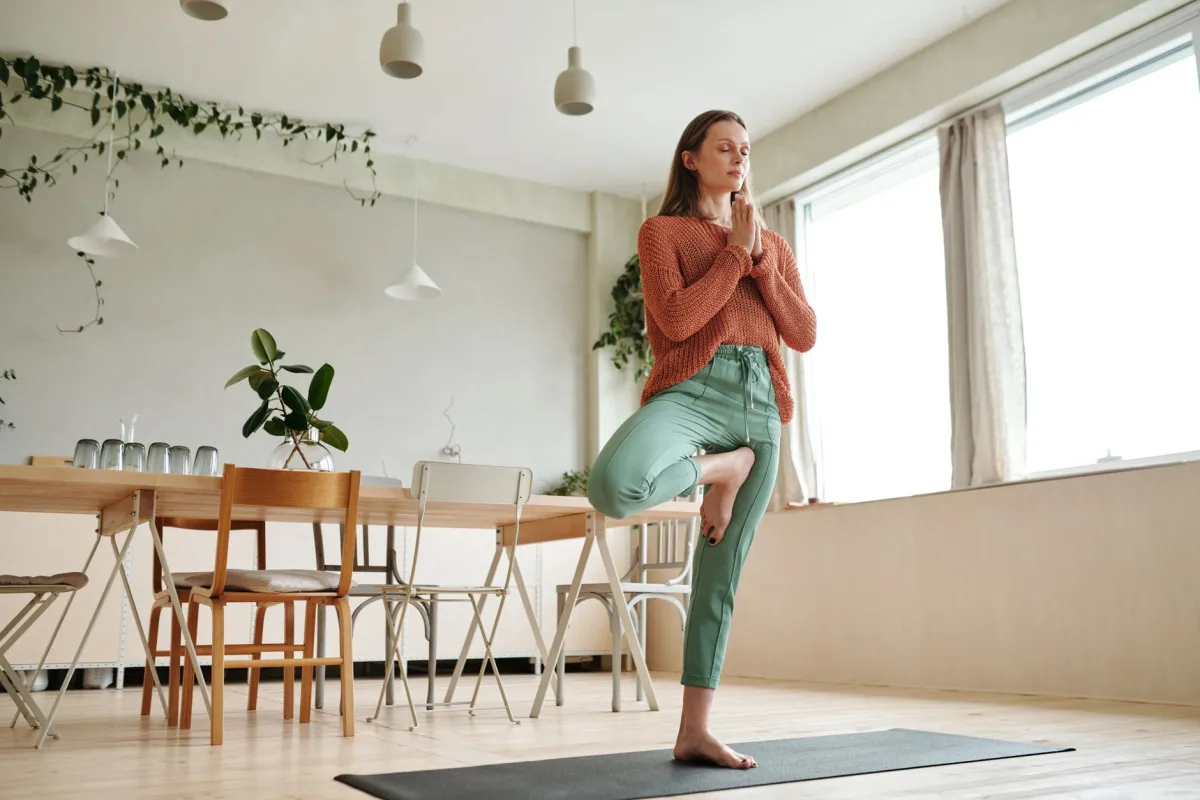
Searching for a chair yoga for beginners PDF usually means you want something you can actually use: a list to tape beside the desk or the kitchen table, not another vague pep talk about gentle movement. Maybe your hips feel locked up by 3 PM. Or getting down onto a mat sounds like a problem you’d rather skip.
- Chair Yoga for Beginners PDF: 40 Poses by Body Area
- How Do You Use This Chair Yoga for Beginners PDF?
- How Can You Make Chair Yoga Easier or Harder?
- What Mistakes Do Chair Yoga Beginners Make?
- Who Should Check With a Doctor Before Chair Yoga?
- What Does the Research Say About Chair Yoga?
- FAQ
- The Bottom Line
Chair yoga is yoga done seated in a chair, or standing while holding onto one for support. That’s the whole idea. The list below is built to be used, so grab a sturdy chair and start with the poses marked Easy.
Chair Yoga for Beginners PDF: 40 Poses by Body Area
Use a sturdy chair with no wheels, set against a wall. Sit near the front edge with your feet flat on the floor. Breathe through your nose if you can, and don’t hold your breath.
- Easy: Start here on day one.
- Moderate: Add these after one to two comfortable weeks.
- Caution: Ask your doctor first if you have osteoporosis, recent surgery or dizziness.
Breathing and Warm-Up
| Pose | Hold or reps | Level | Note |
|---|---|---|---|
| 1. Seated mountain | 5 breaths | Easy | Feet flat, spine tall |
| 2. Belly breathing | 1 to 2 minutes | Easy | Hand on belly, slow exhale |
| 3. Ankle circles | 5 each direction | Easy | Lift one foot slightly |
| 4. Toe and heel lifts | 10 reps | Easy | Wakes up calves and shins |
| 5. Wrist circles | 5 each direction | Easy | Eases keyboard-tired wrists |
| 6. Finger spreads | 10 reps | Easy | Open wide, then soft fist |
| 7. Seated marching | 30 seconds | Easy | Lift knees one at a time |
Neck and Shoulders
| Pose | Hold or reps | Level | Note |
|---|---|---|---|
| 8. Chin tucks | 5 to 8 reps | Easy | Slide chin back, not down |
| 9. Ear to shoulder | 3 breaths per side | Easy | Keep shoulders relaxed and low |
| 10. Slow neck turns | 3 per side | Easy | Stop before any pinching |
| 11. Shoulder rolls | 5 each direction | Easy | Big, slow circles |
| 12. Shoulder shrugs | 8 reps | Easy | Lift on inhale, drop exhaling |
| 13. Seated eagle arms | 3 to 5 breaths | Moderate | Self-hug works too |
| 14. Cactus arms | 5 reps | Easy | Gently squeeze shoulder blades |
Spine and Back
| Pose | Hold or reps | Level | Note |
|---|---|---|---|
| 15. Seated cat-cow | 5 to 8 rounds | Easy | Hands on knees, follow breath |
| 16. Seated side bend | 3 breaths per side | Easy | Reach up, then over |
| 17. Seated twist | 3 breaths per side | Caution | Turn from ribs, not neck |
| 18. Overhead reach | 3 breaths | Easy | Interlace fingers, palms up |
| 19. Seated forward fold | 3 to 5 breaths | Caution | Rise slowly if lightheaded |
| 20. Seated heart opener | 3 breaths | Easy | Hands hold chair back |
| 21. Torso circles | 5 each direction | Easy | Small circles over hips |
Hips and Legs
| Pose | Hold or reps | Level | Note |
|---|---|---|---|
| 22. Seated figure four | 3 to 5 breaths per side | Caution | Ask first after hip replacement |
| 23. Seated knee hug | 3 breaths per side | Easy | Lift knee toward chest |
| 24. Seated hamstring stretch | 3 to 5 breaths per side | Easy | Heel forward, hinge slightly |
| 25. Seated leg extensions | 8 to 10 per side | Easy | Straighten knee, squeeze thigh |
| 26. Seated goddess | 3 to 5 breaths | Moderate | Wide knees, hands on thighs |
| 27. Seated warrior 2 | 3 breaths per side | Moderate | Turn sideways on the chair |
| 28. Sit-to-stand | 5 to 10 reps | Moderate | Use armrests if needed |
Standing With Chair Support
| Pose | Hold or reps | Level | Note |
|---|---|---|---|
| 29. Supported mountain | 5 breaths | Easy | One hand on chair back |
| 30. Calf raises | 8 to 10 reps | Easy | Rise and lower slowly |
| 31. Supported tree pose | 3 to 5 breaths per side | Moderate | Keep toes touching the floor |
| 32. Side leg lifts | 5 to 8 per side | Moderate | Keep torso upright |
| 33. Supported warrior 1 | 3 breaths per side | Moderate | Short stance, hold chair |
| 34. Chair half dog | 3 to 5 breaths | Moderate | Chair against wall, hips back |
Cool-Down and Relaxation
| Pose | Hold or reps | Level | Note |
|---|---|---|---|
| 35. Seated forward rest | 3 to 5 breaths | Caution | Forearms resting on thighs |
| 36. Palming eye rest | 30 to 60 seconds | Easy | Warm palms over closed eyes |
| 37. Counted breathing | 1 to 2 minutes | Easy | Inhale 4, exhale 4 to 6 |
| 38. Seated body scan | 2 to 3 minutes | Easy | Notice each area, head to toe |
| 39. Hand-on-heart breath | 5 breaths | Easy | Slow, calming finish |
| 40. Seated rest | 2 to 5 minutes | Easy | Hands on thighs, eyes closed |
Three Starter Routines
- 5-minute desk reset: Poses 1, 8, 11, 15, 16, 18, 37.
- 10-minute morning wake-up: Poses 2, 3, 7, 11, 15, 16, 20, 24, 25, 29, 30, 40.
- 10-minute evening wind-down: Poses 2, 9, 12, 14, 15, 21, 23, 24, 37, 38, 40.
Stop any pose that causes sharp pain, numbness or dizziness.
How Do You Use This Chair Yoga for Beginners PDF?
The easiest approach is to pick one starter routine, do it most days for two weeks, then mix in new poses from the list. Short, regular sessions are usually easier to stick with than one long session a week, and you don’t need any gear beyond a solid chair.
- Set up your chair: Armless, no wheels, back against a wall. Your knees should sit roughly level with your hips.
- Print and post it: Tape the PDF where you’ll see it, like the fridge or beside your monitor.
- Start with the 5-minute reset: Do it once a day for the first week, ideally at the same time.
- Check off what felt good: Circle the poses you liked and cross out any that caused discomfort.
- Build in week two or three: Move to a 10-minute routine and add one or two Moderate poses.

Expect a little more ease in your movement after a few sessions. Much of that comes from your muscles warming up and getting used to the motion. Mild soreness the next day is normal. Joint pain that lingers is not, so shrink the movement or drop that pose.
If yoga is new to you, our guide to yoga for complete beginners at home covers breathing and pacing basics that carry over well to seated work.
How Can You Make Chair Yoga Easier or Harder?
You can make chair yoga gentler by shrinking each movement, adding props and doing fewer reps. You can make it harder by holding poses longer and spending more time standing. The same 40 poses can serve someone recovering from a long illness and an office worker who just wants a stretch break.
To make it gentler
- Move half as far: A small twist or side bend still counts.
- Add props: A rolled towel behind your lower back, a cushion to sit on, or a belt looped around your foot for hamstring stretches.
- Raise the floor: If your feet don’t reach, rest them on a sturdy book or step.
- Stay seated: Skip the standing poses entirely until your balance feels reliable.
To add challenge
- Hold longer: Stretch from 3 breaths up to 6 to 8 breaths.
- Slow down sit-to-stands: Take about 3 seconds to lower, and try it without using your hands.
- Lighten your grip: In standing poses, move from two hands to one hand to fingertips.
- Link poses: Flow from cat-cow to side bends to twists without pausing.
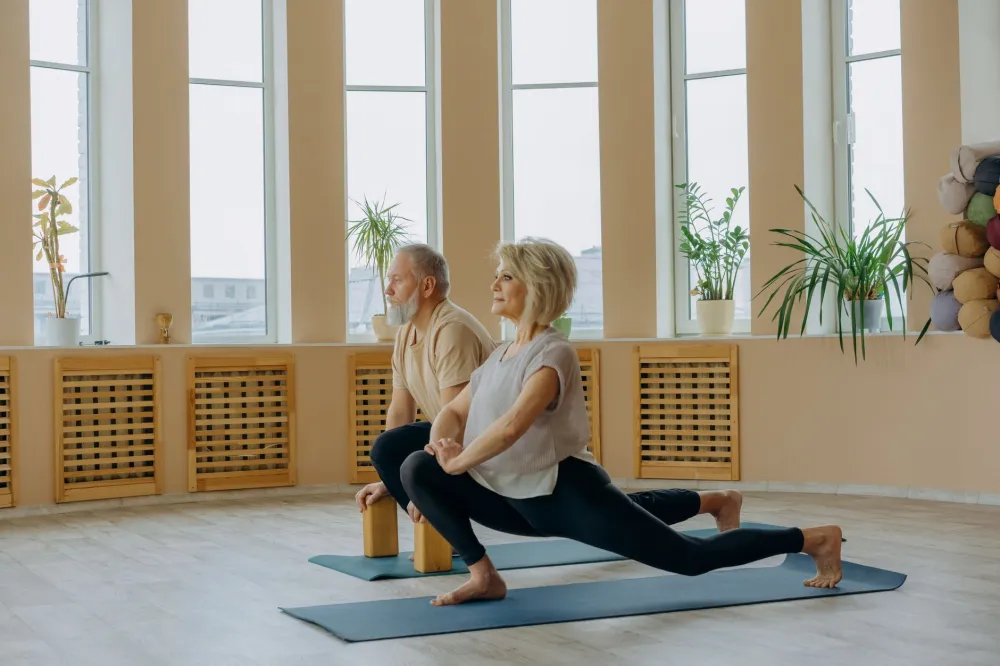
If you sit all day, pairing the neck and spine sections with a better workstation may help more than either one alone. Our article on desk posture and back pain from sitting all day covers the setup side.
What Mistakes Do Chair Yoga Beginners Make?
Most chair yoga mistakes come down to three things: an unstable chair, holding your breath and pushing a stretch past what your body is ready for. All of them are easy to fix, and fixing them is what makes seated yoga comfortable enough to keep doing.
- Wheeled or folding chairs: They can roll or collapse. A solid kitchen chair against a wall is safer.
- Slumping back: Sitting deep in the chair rounds your spine. Scoot forward so your sit bones carry your weight.
- Breath holding: People do this without noticing during twists and leg lifts. If you can’t breathe smoothly, ease off.
- Cranking the neck: In twists, your neck should follow your ribs, not lead.
- Doing all 40 on day one: Tempting, sure. You’ll likely feel it the next morning.

Here’s the thing: a good stretch feels like a mild pull, never sharp or electric. Sharp pain, tingling down an arm or leg, or pain that’s worse the next day means you should stop that pose. If your neck is the complaint, our guide to neck stretches for desk workers has a few gentle options.
Who Should Check With a Doctor Before Chair Yoga?
Talk with your doctor or a physical therapist before starting if you have osteoporosis, a recent surgery, a joint replacement, a heart condition, uncontrolled high blood pressure, frequent dizziness or a history of falls. Pregnancy is another reason to check in first. They can tell you which poses to skip or modify.
Why those groups? Deep forward folds and strong twists can put extra load on fragile spinal bones. Some hip replacements come with movement limits during recovery, and dropping your head forward or standing up fast can make some people lightheaded.
Some symptoms mean you should stop exercising and get medical help promptly, rather than reading on: chest pain or pressure, trouble breathing, a sudden severe headache, new numbness or weakness, or fainting. Pain that is severe or keeps coming back deserves a real medical evaluation too. If your lower back is the main complaint, our roundup of yoga poses that ease lower back tension explains which moves tend to be gentlest.
What Does the Research Say About Chair Yoga?
Research on chair yoga is promising but limited, mostly small, short studies in older adults. Several trials suggest seated yoga may help with flexibility, confidence in balance and everyday joint comfort, including in some people with knee or hip osteoarthritis. Larger, longer studies are still needed before anyone can make firm claims.
Major health organizations generally describe yoga as low-risk for most healthy adults. The National Center for Complementary and Integrative Health, part of the National Institutes of Health (NIH), tracks the research on yoga. The Mayo Clinic discusses it as a mind-body practice that may help with stress, and it is usually framed as a complement to medical care, not a substitute.

How does chair yoga fit with exercise guidelines? The CDC recommends that adults get around 150 minutes of moderate activity a week, plus muscle-strengthening work on at least two days, and it encourages balance activities for older adults. Chair yoga mostly covers flexibility and balance. Sit-to-stands and leg extensions add some strength, but a daily walk or our guide to rebuilding flexibility after 40 can round things out.
Chair yoga myths vs facts
| Myth | Fact |
|---|---|
| It only counts on a mat | Seated poses use the same principles |
| It’s just for seniors | Desk workers benefit from breaks too |
| Deeper stretch means better results | A comfortable range is safer, often enough |
| It replaces all other exercise | It complements walking and strength work |
| You need flexibility to start | Flexibility tends to build with practice |
The short answer? Chair yoga is a sensible, low-risk way to move more, with modest potential benefits. It just isn’t magic.
FAQ
The Bottom Line
This chair yoga for beginners PDF gives you 40 poses, clear difficulty levels and three starter routines, all done in a sturdy chair with no mat required. Start with the 5-minute desk reset once a day, keep every stretch in a comfortable range and keep breathing. After a couple of weeks, add Moderate poses or move up to the 10-minute routine. If you have osteoporosis, a recent surgery, balance problems or a heart condition, check with your doctor first, and get medical help right away for chest pain, dizziness or numbness.
This article is for informational purposes only and is not a substitute for professional medical advice, diagnosis, or treatment. Always consult a qualified healthcare provider about your specific situation. If you experience severe or sudden symptoms, seek medical care immediately.

Back and Neck Pain
Browse every related article on this topic in one place.

1 thought on “Chair Yoga for Beginners PDF: 40 Simple Poses to Print”
Comments are closed.