

You spend roughly a third of your life asleep, and if you wake up every morning with a stiff or aching back, what happens during those hours matters far more than you probably think. The good news? A simple position change, sometimes with just one pillow, can help more than any gadget you’ve seen advertised at 2 a.m.
- Why Does Sleep Position Affect Your Back?
- The Best Sleeping Positions for Back Pain
- The Worst Sleeping Positions for Back Pain
- Sleeping Position Comparison at a Glance
- Myths About Sleep and Back Pain: What the Research Actually Says
- Practical Steps You Can Take Tonight
- Does Your Mattress Actually Matter?
- When Should You See a Doctor About Back Pain?
- FAQ
- The Bottom Line
Why Does Sleep Position Affect Your Back?
Your spine has a natural S-shaped curve. The goal of any sleeping position is to maintain that curve without forcing it into an awkward angle for six to eight hours straight. When your spine stays in a neutral position, the muscles, ligaments, and intervertebral discs (the cushion-like pads between each vertebra) can actually rest and recover overnight.
When your spine is twisted, compressed, or hyperextended during sleep, those same structures stay under low-level strain for hours. Over time, it adds up. According to the Mayo Clinic, poor sleep posture can worsen existing back conditions and, for some people, trigger new aches that weren’t there before.
There’s one more piece: your mattress and pillows. Even a great sleeping position won’t help much on a mattress that sags in the middle or a pillow so thick it cranks your neck sideways all night. If neck stiffness also bothers you, the guide on how to choose the right pillow for neck pain pairs well with this one.
The Best Sleeping Positions for Back Pain
Side Sleeping With a Pillow Between Your Knees
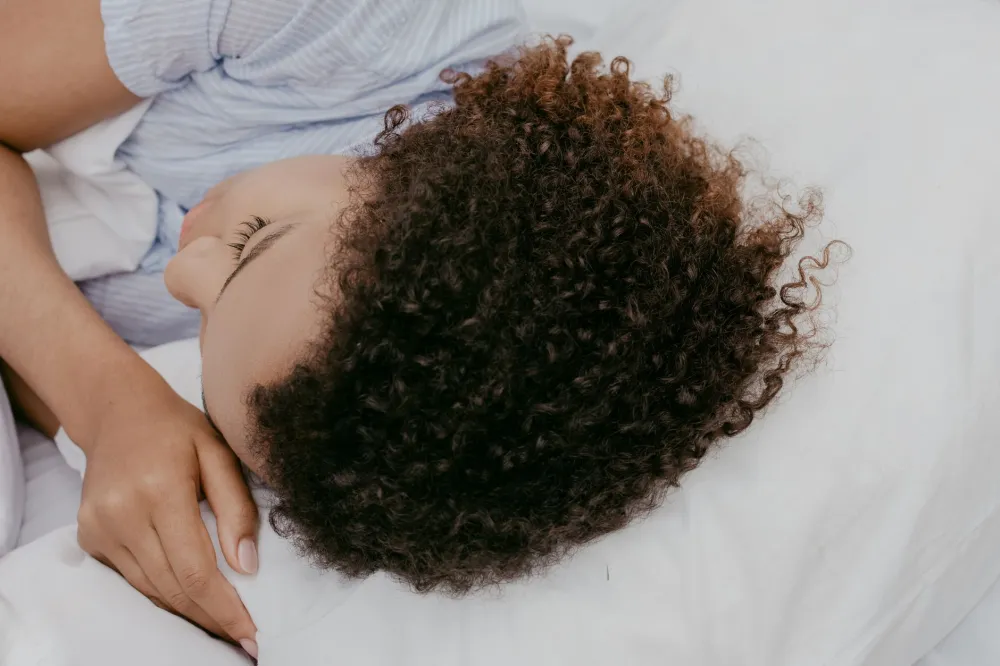
Side sleeping is the most popular position in the US, and for most people with low back pain, it’s also one of the safest. The trick is what you do with your knees. When you sleep on your side without support, your top leg tends to drop forward, rotating your pelvis and putting a twisting force on your lower spine.
A standard bed pillow or wedge pillow between your knees keeps your hips, pelvis, and spine stacked in a roughly neutral line. Many people notice noticeably less morning stiffness within a week or two. Research in sleep and musculoskeletal journals generally supports side sleeping as a spine-friendly option, though which side you choose (left vs. right) depends more on other factors like acid reflux or pregnancy than on back pain itself.
Back Sleeping With a Pillow Under Your Knees
Sleeping flat on your back is often considered the gold standard for spinal alignment because it distributes your body weight evenly across the largest surface area. The lower spine, however, naturally curves slightly upward when you lie flat, which can leave that section without support and cause aching by morning.
The fix is simple: place a pillow under your knees so they’re slightly bent. This flattens the lower curve just enough to reduce pressure on the discs and the muscles around them. Harvard Health notes that back sleeping with knee support is one of the most commonly recommended positions for people managing lower back pain, because it keeps the spine closest to its natural neutral curve.
The downside for some people is that back sleeping can worsen snoring or sleep apnea, a condition where breathing repeatedly stops during sleep. If that applies to you, side sleeping with a pillow between the knees is usually the better choice.
The Reclined Position: A Useful Option for Some
If you have a specific condition called isthmic spondylolisthesis, where one vertebra slips slightly forward over the one below it, sleeping in a slightly reclined position (think adjustable bed or a wedge under the upper mattress) may reduce pain by opening up the spaces between the vertebrae. This isn’t the right call for everyone, but it shows that “the best position” isn’t truly universal. Your specific diagnosis matters.

The Worst Sleeping Positions for Back Pain
Stomach Sleeping: The Clear Loser
Stomach sleeping is, without much debate, the hardest position on your back and neck. To breathe when you’re face-down, you have to turn your head to one side and hold that rotation for hours. That alone strains the cervical spine (the seven vertebrae in your neck) and the muscles alongside it.
At the same time, lying on your stomach pushes your lower spine into an exaggerated curve called hyperextension. This compresses the small joints at the back of each vertebra (called facet joints) and puts extra pressure on the discs between them. For people with degenerative disc disease or lumbar stenosis (narrowing of the spinal canal), this can make symptoms worse over time.
Here’s the thing: many stomach sleepers feel fine in the moment. That’s partly because face-down can feel comforting, especially if your stomach feels unsettled. But the structural strain is still happening, even if you don’t notice it right away. If you’re a committed stomach sleeper and can’t break the habit, placing a thin pillow under your pelvis rather than under your head can reduce some of the lower spine compression.
Side Sleeping Without Support: Better, But Not Ideal
Side sleeping without a pillow between the knees is still better than stomach sleeping, but it’s not ideal for back pain. The dropped-leg problem described earlier creates a rotational pull on your lower spine that, over a full night, can aggravate the muscles and ligaments around the sacroiliac joint (the joint connecting your lower spine to your pelvis). The fix, again, is the pillow.
Sleeping Position Comparison at a Glance
| Position | Spinal Impact | Best For | Key Prop Needed | Overall Rating |
|---|---|---|---|---|
| Back with pillow under knees | Neutral curve, even weight | Most back pain types | Pillow under knees | Excellent |
| Side with pillow between knees | Well-aligned with support | Hip, SI joint, pregnancy | Pillow between knees | Excellent |
| Side without support | Mild rotational strain | Snorers, better than stomach | Ideally a body pillow | Fair |
| Reclined (adjustable bed) | Opens vertebral spaces | Spondylolisthesis | Adjustable base or wedge | Good (condition-specific) |
| Stomach sleeping | Hyperextension, neck rotation | Not recommended | Pelvis pillow if unavoidable | Poor |

Myths About Sleep and Back Pain: What the Research Actually Says
A few ideas about sleeping and back pain get repeated so often that they feel like fact. Here’s what the evidence actually shows.
Myth: A firm mattress is always better for back pain. This one persists, but the research complicates it significantly. A study published in The Lancet found that people with chronic low back pain actually reported better outcomes on medium-firm mattresses compared to firm ones. The goal is support without pressure points, not hardness for its own sake. If you’re sinking into a hammock-like sag, that’s a problem. But sleeping on something that feels like a concrete slab isn’t the answer either.
Myth: You should stay in one position all night. Shifting positions during sleep is completely normal and, for most people, beneficial. Your body naturally moves to redistribute pressure. The goal isn’t to stay rigid in a “correct” position all night; it’s to start in a good position and set up your pillow support so that common shifts (from side to back, for instance) still keep you reasonably aligned.
Myth: Rest is always the best medicine for back pain. This one matters. The evidence on bed rest for back pain is actually clear: prolonged rest tends to make most types of back pain worse, not better, by weakening the muscles that support your spine. As covered in the breakdown of walking versus rest for back pain, gentle movement is generally far more effective than staying in bed. Your sleep position matters, but it works best alongside staying active during the day.
Practical Steps You Can Take Tonight
You don’t need expensive equipment to make a real difference. Here’s how to start as simply as possible.
If daytime habits are also contributing to your pain, the article on desk posture and back pain from sitting all day is a natural complement to what you do at night. And if your back pain seems to start at the gym, the breakdown of back pain after the gym covers the most common culprits clearly.
For those whose back pain also involves nerve-related leg pain or a radiating ache down the buttocks or thigh, the article on what actually helps with sciatica pain addresses both sleeping and waking strategies for that specific pattern.
Does Your Mattress Actually Matter?
Short answer: yes, but probably not as much as position does. A severely worn-out mattress that no longer provides even support can undermine even perfect sleep positioning. The Sleep Foundation generally recommends replacing a mattress every 7 to 10 years, or sooner if you notice visible sagging or wake up feeling worse than when you went to bed.
Medium-firm options tend to work well for most adults with back pain, but individual body weight, sleep position, and the specific nature of your pain all play a role. If budget is tight, a mattress topper made of foam or latex placed on an aging mattress can sometimes improve how it feels meaningfully without the full cost of replacement.
When Should You See a Doctor About Back Pain?
Sleep position adjustments and supportive pillows can genuinely help with everyday muscle tension and postural back pain. But some back pain signals that something more is going on and deserves a real medical evaluation, not just a new pillow.
See a doctor promptly if your back pain comes with any of the following:
- Numbness or tingling in your legs, feet, or groin area
- Weakness in your legs that affects how you walk or stand
- Loss of bladder or bowel control, which can signal a serious nerve compression emergency
- Pain following a fall, accident, or injury
- Unexplained weight loss alongside back pain
- Pain that is constant and doesn’t improve with any position change, especially at night
- Fever alongside back pain, which may suggest infection
These are red-flag symptoms. They don’t mean the worst-case scenario is guaranteed, but they do mean you should call your doctor rather than trying to self-manage with lifestyle changes alone. Severe or sudden back pain always deserves professional assessment.
For back pain that hasn’t responded to position changes, gentle movement, and basic self-care after four to six weeks, a primary care doctor or a physical therapist can help identify the specific cause and create a plan that actually targets it. In some cases, options like spinal decompression therapy may be worth exploring under professional guidance.
FAQ
The Bottom Line
The best sleeping positions for back pain are side sleeping with a pillow between your knees and back sleeping with a pillow under your knees, both of which help keep your spine in a neutral, supported position overnight. Stomach sleeping is consistently the hardest position on the lower spine and neck and is worth avoiding if back pain is a concern for you. Start tonight with whichever supported position feels most natural, give your body two weeks to adjust, and pair the change with gentle daytime movement for the best results. If your pain is severe, worsening, or comes with neurological symptoms like numbness or leg weakness, see a doctor, not a blog.
This article is for informational purposes only and is not a substitute for professional medical advice, diagnosis, or treatment. Always consult a qualified healthcare provider about your specific situation. If you experience severe or sudden symptoms, seek medical care immediately.